

World’s largest sail cruise ship sets speed record during sea trials ahead of May delivery and ultra-luxury service launch
The world’s largest sail-powered cruise ship has set a new performance benchmark during sea trials, achieving speeds that builder Chantiers de l’Atlantique describes as unprecedented for a sailing vessel of this size.
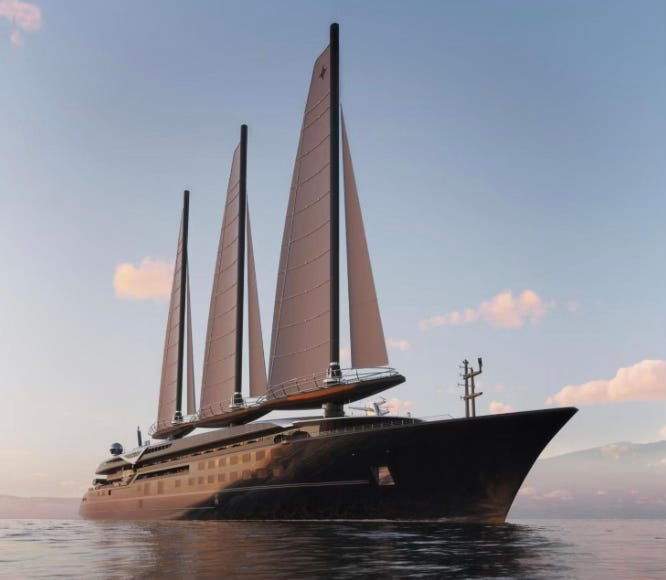
The Orient Express Corinthian, a 25,200 gross ton cruise ship measuring 220 meters in length, reached 12 knots under sail alone with a 20-knot wind during recent propulsion tests. The vessel is scheduled for delivery and service entry in May 2026, marking Accor Group’s debut in the cruise sector through its storied Orient Express brand.
Engineering Ambition Meets Carbon Fiber Reality
The ship’s revolutionary propulsion system sets it apart from conventional cruise vessels and represents the most ambitious application of Chantiers de l’Atlantique’s Solid Sail technology to date. The system features three masts with a total sail surface of 4,500 square meters—roughly equivalent to two-thirds of a football field—supplemented by an LNG-fueled motor for auxiliary power and maneuvering.
To put the scale in perspective, the next largest sail cruise ships currently operating are Wind Star and Club Med vessels at 15,000 gross tons, making the Corinthian nearly 70% larger. This isn’t incremental improvement; it’s a category expansion.
Each of the three 69-meter carbon fiber masts provides 1,500 square meters of sail area, mounted on unique balestron rigs that allow 360-degree rotation and tilting up to 70 degrees. This flexibility enables the vessel to navigate under low bridges and other obstacles despite a maximum air draft of 100 meters—taller than the Statue of Liberty from base to torch.
Two Decades from Drawing Board to Deployment
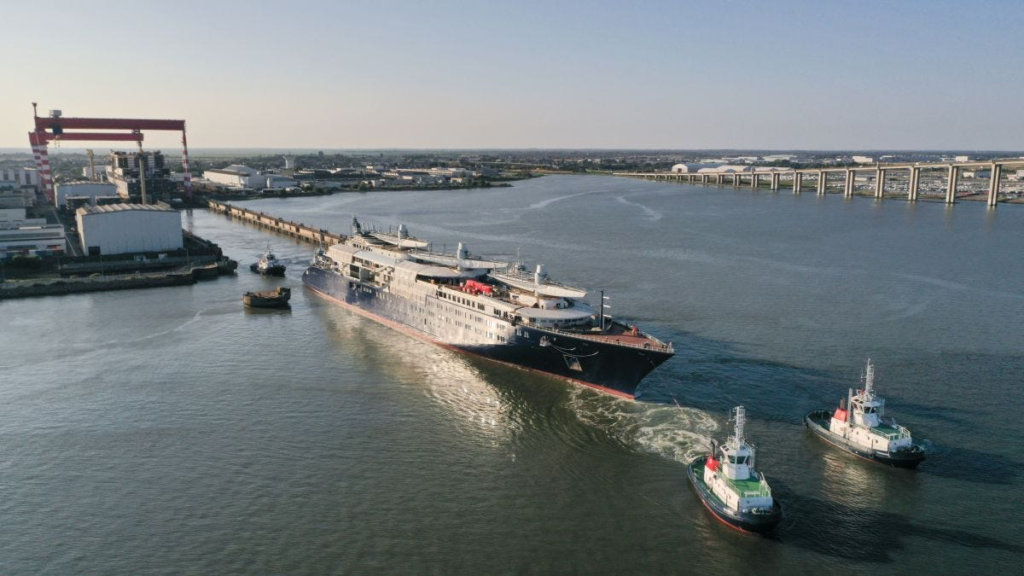
Development of this technology has been extensive and methodical. Chantiers de l’Atlantique released its first sailing ship concept, Eoseas, in 2009, conducting tests between 2016 and 2019 with a one-fifth-size demonstrator before installing a full-scale demonstration at its St. Nazaire yard. The shipyard effectively bet that luxury cruise passengers would embrace sailing vessels if the experience matched five-star expectations.
That gamble appears to have paid off. The vessel accommodates 110 passengers in 54 suites, featuring five restaurants, private dining spaces, suites ranging from 485 to nearly 2,500 square feet, a fitness and yoga studio, spa, outdoor pool, and retractable marina. The passenger-to-space ratio rivals the most exclusive boutique hotels afloat.
Construction progress has moved rapidly since the vessel was floated in June 2025 after approximately four months of assembly, with the three masts raised by September 2025. A sister ship, Orient Express Olympian, is already under construction with delivery planned for spring 2027, suggesting Accor has confidence in the market reception.
Hotel Brands Redefine Luxury Cruising
This project aligns with a broader movement in ultra-luxury cruising that’s reshaping industry economics. Four Seasons recently took delivery of its first ultra-luxury cruise yacht for spring service, while Ritz-Carlton entered the segment in 2022 with the Evrima, followed by two larger vessels, Ilma and Luminara. These hotel brand entries are expected to attract travelers who previously dismissed cruising while establishing premium pricing that makes traditional luxury lines look middle-market.
The strategic calculation is straightforward: hotel brands bring established luxury credentials, loyal customer bases, and the ability to command rates that would make traditional cruise executives blanch. When your core business involves $1,500-per-night hotel rooms, a $5,000-per-night suite at sea doesn’t require a mental adjustment.
The Waterline Report
The Corinthian’s successful trials validate more than engineering specifications—they confirm that wind propulsion scales to vessels that would have seemed impossible a generation ago. For the cruise industry facing intensifying emissions scrutiny, this matters enormously. The vessel demonstrates that sustainability and luxury aren’t mutually exclusive, a message that resonates with affluent travelers increasingly concerned about their carbon footprint. Shipbuilders and cruise operators should note that Chantiers de l’Atlantique isn’t treating this as a one-off experiment; the second hull under construction signals production capability. The question for the industry isn’t whether sail technology works at luxury cruise scale—it’s who moves next and how quickly competitors can respond.