

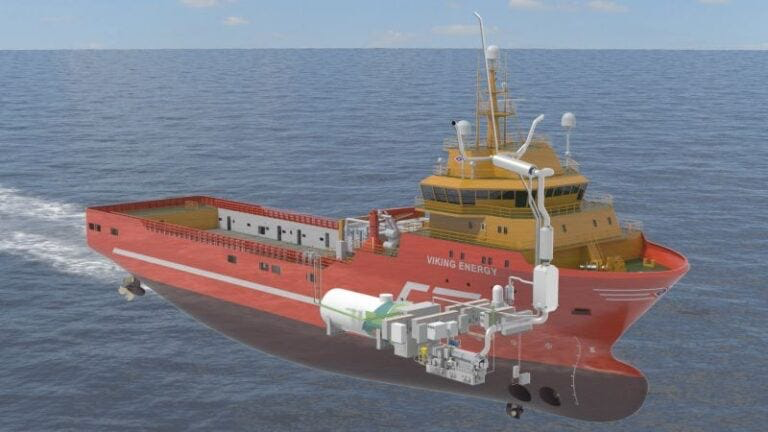
Eidesvik Offshore contracted Halsnøy Dokk to retrofit the PSV Viking Energy with a Wärtsilä ammonia dual-fuel engine. Conversion is scheduled for completion in autumn 2026
A Project Two Decades in the Making
The platform supply vessel Viking Energy has been operating continuously for Equinor since its delivery in 2003. For more than twenty years, the 95-metre vessel has quietly sustained offshore operations on the Norwegian Continental Shelf. Now, that same vessel is about to write a new chapter: upon completion of an ambitious retrofit scheduled for autumn 2026, it will become the first offshore vessel in the world to operate on ammonia.
Norwegian offshore owner Eidesvik Offshore has contracted Halsnøy Dokk to carry out the conversion. Prefabrication of steel and piping systems will begin in spring 2026, with the full scope covering major structural modifications, a new ammonia dual-fuel engine, dedicated fuel tanks and fuel systems, and the safety integrations required to handle ammonia in live offshore conditions.The Technology Stack
At the heart of the conversion is Wärtsilä’s 25 dual-fuel engine, capable of running on both ammonia and marine gas oil — providing the operational flexibility essential for a vessel in active charter. Ship design and engineering is the responsibility of Breeze Ship Design, and the design package has already received a preliminary assessment from the Norwegian Maritime Authority (NMA), clearing a critical regulatory hurdle ahead of construction.
The integrated system combines engine technology, ammonia fuel supply, and safety systems into a single cohesive package. Once completed, the vessel has the potential to cut greenhouse gas emissions by 70% or more compared to conventional marine gas oil operations.
EU Funding, Industry Consortium
The retrofit is part of the EU-funded Apollo project, led by Maritime CleanTech, which is specifically designed to address the technical, procedural, and regulatory barriers facing ammonia as a maritime fuel. Equinor is providing direct financial support for the conversion. The wider consortium includes DEME Group, VTT Technical Research Centre of Finland, and Greece’s National Centre for Scientific Research ‘Demokritos’.
Critically, this is not a controlled laboratory test or a pilot on a purpose-built newbuild. It is the first project in the offshore industry to test ammonia as a propulsion fuel on a vessel in normal commercial operation — a distinction that matters enormously for the technology’s path to broader adoption.
The Waterline Report
The Viking Energy conversion is the most credible proof-of-concept ammonia has received in the offshore sector to date. It is one thing to run a vessel on ammonia in controlled conditions; it is another to do so while under contract to one of Europe’s largest oil and gas operators. If this works as designed, the implications for fleet decarbonisation on the NCS — and beyond — will be hard to ignore.