

Fincantieri launches the first of four next-gen Italian Navy OPVs featuring a two-operator cockpit that sets a new benchmark for naval automation and crewing efficiency
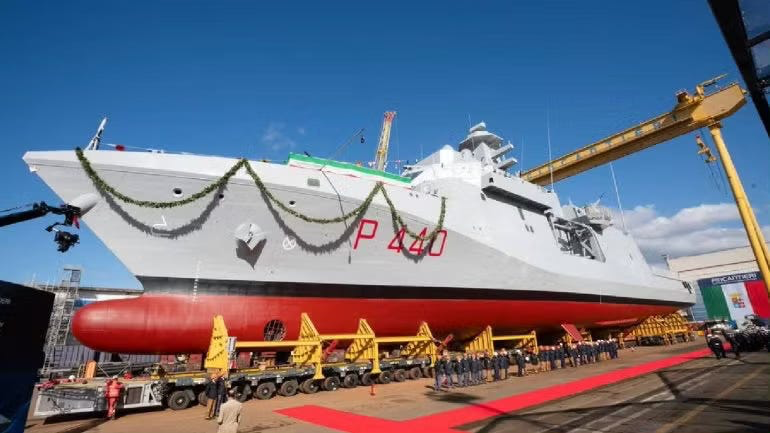
Hull in the Water
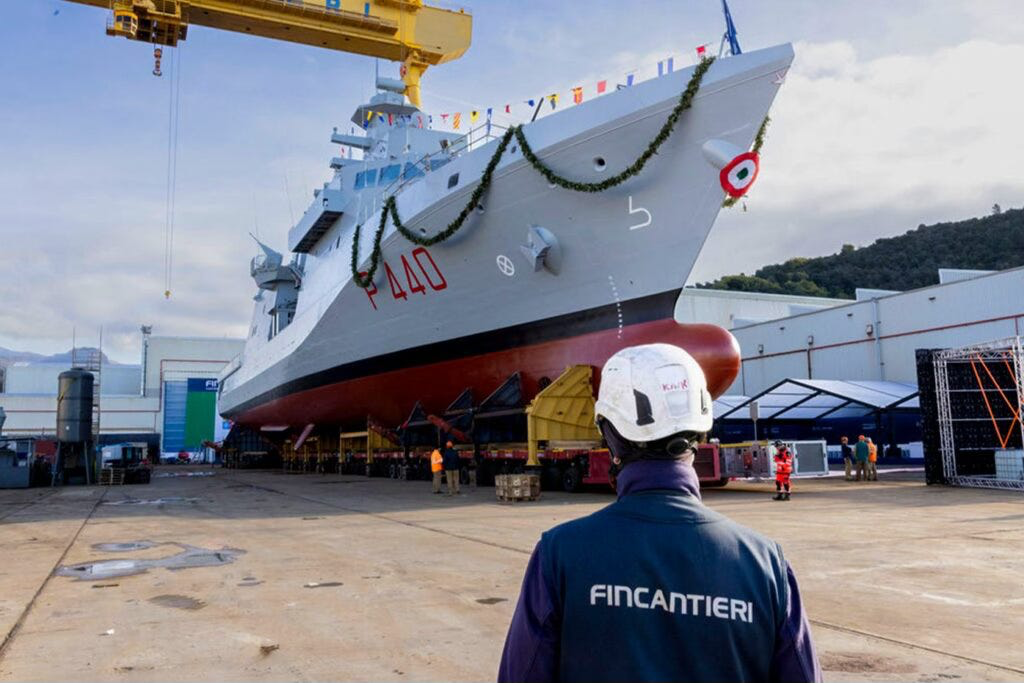
Fincantieri launched the Ugolino Vivaldi (P 440) on February 21 at its historic Riva Trigoso shipyard on the Ligurian coast, marking the first of four next-generation offshore patrol vessels ordered by the Italian Navy under a contract awarded to Orizzonte Sistemi Navali — the joint venture between Fincantieri (51%) and Leonardo (49%) established to deliver Italy’s most complex naval programs. The ceremony marks the transition from a construction project into a functioning hull, with delivery to the Marina Militare scheduled for 2027 and the remaining three sister vessels to follow at intervals thereafter.
The keel of the Vivaldi was laid in December 2024, making the launch approximately 14 months into build — a pace that reflects the maturity and efficiency of Fincantieri’s modular construction methodology at Riva Trigoso, a yard with a centuries-long history of naval shipbuilding and the physical and workforce infrastructure to match. The program is managed by Italy’s Naval Armaments Directorate under the Ministry of Defence, and sits within a broader Italian naval modernization effort that also encompasses the PPA multi-purpose patrol vessels and the ongoing DDX next-generation destroyer program.
A Platform Built for the Modern Mediterranean
At approximately 95 meters in length, with a full load displacement of around 2,400 tons and accommodation for a complement of 93 personnel, the Vivaldi class represents a significant capability and technological step beyond the vessels it is designed to replace. The OPV’s operational mission set is deliberately broad: maritime presence and surveillance, patrol and traffic monitoring across Italy’s maritime approaches, protection of the exclusive economic zone, surveillance and protection of undersea communication cables and critical offshore infrastructure, and environmental response including hazardous spill containment operations in the Mediterranean basin.
That operational breadth reflects a strategic reality that Italy — and indeed most European maritime nations — now face. The central Mediterranean has become one of the most operationally demanding maritime environments in the world, combining the challenges of migration flows, energy corridor security, Russian naval activity, and the protection of the dense network of subsea pipelines and data cables that underpin European connectivity. Deploying capable, modern OPVs to manage this environment directly frees Italy’s higher-end frigates and destroyers for NATO deterrence commitments in the North Atlantic and the Baltic — a force structure dividend that justifies the program’s investment on purely operational grounds, before the technology case has even been made.
The Technology That Defines the Class
The defining innovation of the Vivaldi class is not her hull form, weapons fit, or propulsion arrangement — it is the integrated naval cockpit jointly developed by Fincantieri NexTech and Leonardo, which represents the most significant step-change in OPV operational architecture in a generation. Originally conceived for Italy’s larger PPA multi-purpose combat ships — vessels operating at a significantly higher level of operational complexity — the cockpit system has been successfully scaled and adapted to the OPV platform, bringing large-ship automation philosophy to a class that has traditionally been operated with conventional, task-segregated bridge and engineering consoles.
The cockpit enables just two operators — a pilot and co-pilot — to simultaneously manage propulsion, steering, platform systems, and selected combat management functions from a single integrated workstation environment. The reduction in crew workload this represents is substantial: what would conventionally require multiple watch stations, each dedicated to a specific system domain, is consolidated into a unified operational picture that allows two trained operators to maintain full situational awareness and system control across the vessel’s functional envelope. The gains in reaction time, decision speed, and operational resilience — particularly in degraded-crew or high-stress scenarios — are significant and directly translatable into operational effectiveness.
The Industry Significance
For Fincantieri, the Vivaldi launch reinforces the FCX product family and positions the company’s patrol vessel offering as a benchmark in export markets where operators across Southeast Asia, the Middle East, and Latin America are actively seeking platforms that combine modern automation, reduced through-life crewing costs, and multi-role capability. The two-operator cockpit concept is particularly significant in export terms: in navies where skilled watchkeeping personnel are a constrained resource, the ability to compress crewing requirements without sacrificing operational capability is a decisive procurement differentiator. The question for the global patrol vessel market is not whether this automation philosophy will spread — it is how quickly.
The Waterline Report
The Ugolino Vivaldi is a well-timed proof of concept. Italy’s shipbuilding industry, led by Fincantieri and enabled by the Leonardo-Fincantieri industrial partnership at Orizzonte, has demonstrated that the automation advances pioneered in large combat vessels can be successfully migrated down the displacement scale to the OPV tier. If the integrated cockpit performs as designed through sea trials and initial operational service, it will set a new baseline expectation for what a modern patrol vessel should be capable of delivering — and Fincantieri will be well positioned to define that standard for a global market hungry for the answer.