

Dutch firm Wattlab has validated solar power for bulk carriers and is now targeting Panamax and Capesize segments after cutting hotel load by 20% on two vessels
Dutch startup moves solar from experiment to commercial reality aboard bulk carriers — with over 200 fleet inquiries already in hand
A Netherlands-based technology firm has cleared what many in the shipping industry considered the most stubborn obstacle to onboard solar power: proving that it actually works, at sea, without disrupting cargo operations — and that the numbers stack up commercially.
From pilot to proven
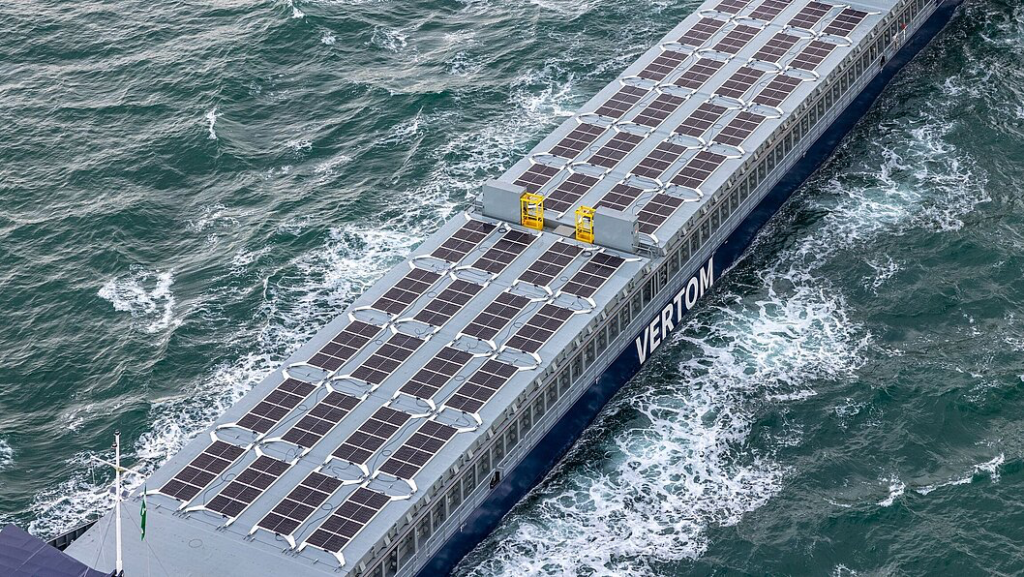
Wattlab’s Solar Flatrack system completed two successive pilot deployments before the company declared readiness for broader market entry. The first trial ran aboard the Vertom Anette, a 7,292 dwt general cargo vessel, in collaboration with Dutch research institute TNO and shipping company Vertom. Lessons from that project were carried directly into the second deployment, on the Vertom Tula, where 44 Solar Flatracks now cut approximately 20% of the vessel’s hotel load.
The Vertom Tula‘s system delivers 79 kilowatts-peak of renewable power and is connected directly to the ship’s 400-volt AC hotel load switchboard, divided into four independent solar groups. Installation took a single day at the Port of Harlingen, using standard container twist-lock fittings.
Both projects were co-financed by the European Union’s Just Transition Fund, part of the broader European Green Deal framework targeting climate neutrality by 2050.
Designed for working ships
The system’s commercial proposition hinges on one critical feature: it does not compromise cargo operations. Solar panels can stay in place during loading and unloading cycles, and if a specific cargo type requires clear deck access, the entire array can be disconnected and stacked within the footprint of a single 20-foot container.
By reducing auxiliary fuel consumption, the system directly improves a vessel’s standing on key regulatory indicators, including the Carbon Intensity Indicator and the Energy Efficiency Existing Ship Index. It also supports compliance with the EU’s FuelEU Maritime regulation and the EU Emissions Trading System.
Wattlab estimates a return on investment of three to five years — a timeframe that has attracted considerable commercial attention. The company reports having engaged with more than 200 international parties interested in deploying Solar Flatracks across their fleets.
Scaling toward Panamax and Capesize
Wattlab’s current technology covers vessels up to and including the Supramax segment, roughly 60,000 dwt. Development work has now begun on solutions for the Panamax and Capesize sectors — a move that, if successful, would extend the system’s reach to the bulk carrier classes that dominate global dry bulk trade volumes.
CEO Bo Salet acknowledged that the two pilot projects provided essential operational intelligence beyond pure technical validation. Understanding crew workflows, cargo handling patterns and seakeeping behavior in varied conditions informed a significant upgrade to the Flatrack design before the Vertom Tula installation.
The Waterline Report
The shipping industry has a long history of solar power pilots that never graduated to commercial relevance. Wattlab’s path — systematic testing, independent performance validation by TNO, and a deliberate focus on operational compatibility rather than raw output numbers — represents a more disciplined approach than most predecessors. The 200-party inquiry figure is a meaningful data point: it suggests the market is no longer asking whether solar belongs on ships, but how quickly it can be scaled. For owners already managing CII pressure and EU ETS costs, a three-to-five-year payback on a system that installs in a single day is a proposition that deserves serious analysis.